
GOOD BASEBALL: One Goddamn Week
A man raced The Freeze and briefly became airborne, Willy Adames forgot the outs during a podcast, and Bob Uecker got turned into Milwaukee infrastructure.


Welcome to GOOD BASEBALL.
This is the part of Monday where we take the week in baseball, empty it onto the table, and try to sort it into piles like a man organizing a junk drawer during a mild emotional crisis.
Here’s the good stuff. Here’s the weird stuff. Here’s the stuff baseball leaves in the fridge too long and somehow still serves us every week. A nasty splitter. A Chapman foot-save. The Freeze turning another confident adult into a public safety video.
Very serious business.
Baseball, once again, spent the week proving it is the only sport that can be beautiful, stupid, politically exhausting, historically specific, and shaped like a Looney Tunes accident all at the same time. The Giants celebrated in Dodger Stadium and HR had to review the footage. Red Sox fans put paper bags on their heads because sometimes shame needs accessories. Willy Adames did a podcast on base and forgot the outs because content is undefeated and undefeated things are dangerous.
We also got Bob Uecker on a 100-foot mural, the Dodgers discovering Depression-era suffering, 1,500 shirtless dudes at Busch Stadium turning left field into a bachelor party with playoff implications, and Pete Crow-Armstrong hearing The Undertaker gong mid-at-bat like baseball had suddenly been booked by Vince McMahon.
So, yes, baseball had another deeply baseball week.
Let’s get into it.

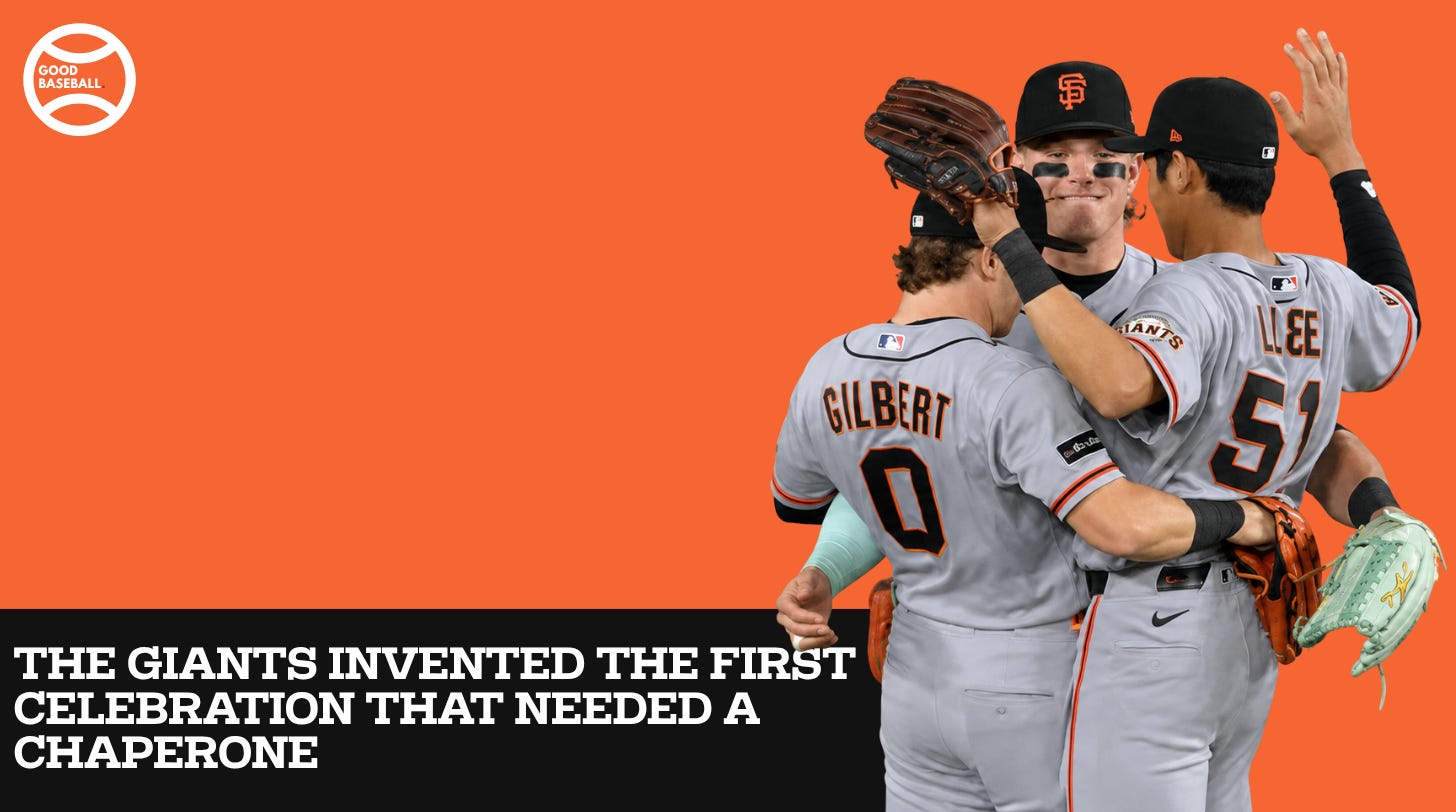
Baseball celebrations are supposed to be stupid. That’s part of the agreement. Every sport has its own language of happiness. Football players do choreographed dances. Basketball players scream after making layups while down 17 in February. Hockey players celebrate by gently attacking each other against glass.
Baseball is different. Baseball happiness is usually more controlled because the sport is run by imaginary uncles who believe every emotion after 1968 is a slippery slope. Hit a home run? Jog respectfully. Strike somebody out? Maybe yell once, but only if you have earned enough service time. Flip a bat too aggressively and half the sport acts like you keyed their Buick.
So of course the San Francisco Giants went into Dodger Stadium, beat the Dodgers 9–3, and celebrated in the outfield like three guys trying to explain to airport security that “it’s actually an inside joke.”
The Giants needed that win, too. They came in under .500, walked into the rich neighbor’s house, ate the good cereal, touched the thermostat, and left with a division-rival road win. That part matters. The Dodgers are not just the Dodgers. They are baseball’s luxury hotel lobby. They have the kind of roster where every inning feels like someone important might emerge from behind a velvet curtain holding a $700 bat. So when the Giants beat them, especially in Los Angeles, I understand wanting to celebrate.
I just did not expect the celebration to look like a deleted scene from Magic Mike: Utility Outfielders.
And this is where baseball becomes beautiful. Not because the celebration was good. I am not even sure “good” applies here. Something happened. People saw it. Families had to explain it. Jomboy probably had to open a second laptop. But it was undeniably baseball, because baseball is the only sport where a team can win one game in May, perform a suspicious outfield ritual, get roasted online by the entire internet, and then everyone has to ask the very serious strategic question:
Is this the thing that saves the season?
Because baseball players are deeply normal until they are not, and then they become medieval villagers. If a guy eats the same sandwich before a three-hit game, that sandwich is now part of the organization. If a reliever does not wash his socks during a scoreless streak, those socks become an heirloom. If three outfielders do whatever the Giants did after beating the Dodgers, then congratulations, that is now either a scandal, a curse, or a rallying point.
Possibly all three.
The funny part is not even the celebration itself. The funny part is that baseball has rules for everything except the things it actually needs rules for. There are balk rules, there are pitch clock rules, mound visit rules, replay rules, lineup card rules, unwritten rules, written rules, rules that are just old men clearing their throats. But apparently nobody ever thought to include: “After the final out, outfielders may not form a public fornication problem.”
That feels like an oversight.
Still, I respect the honesty of it. Winning makes people weird. Winning against the Dodgers makes people even weirder. Winning against the Dodgers when your season has been wobbling around like a shopping cart with one bad wheel? That is how you end up in center field inventing a celebration that makes the internet say, “Hey man, everything okay over there?”
And honestly, that might be the thesis of baseball in May. Nobody knows anything yet. Everybody is trying to convince themselves they have found the thing. A lineup tweak. A new bullpen role. A lucky hoodie. A cursed handshake. Three outfielders doing performance art after a road win.
The Giants may not have fixed their season.
But for one night, they beat the Dodgers, broke the internet’s brain, and reminded everyone that baseball is at its best when it stops pretending to be dignified and starts acting like the world’s longest-running inside joke.
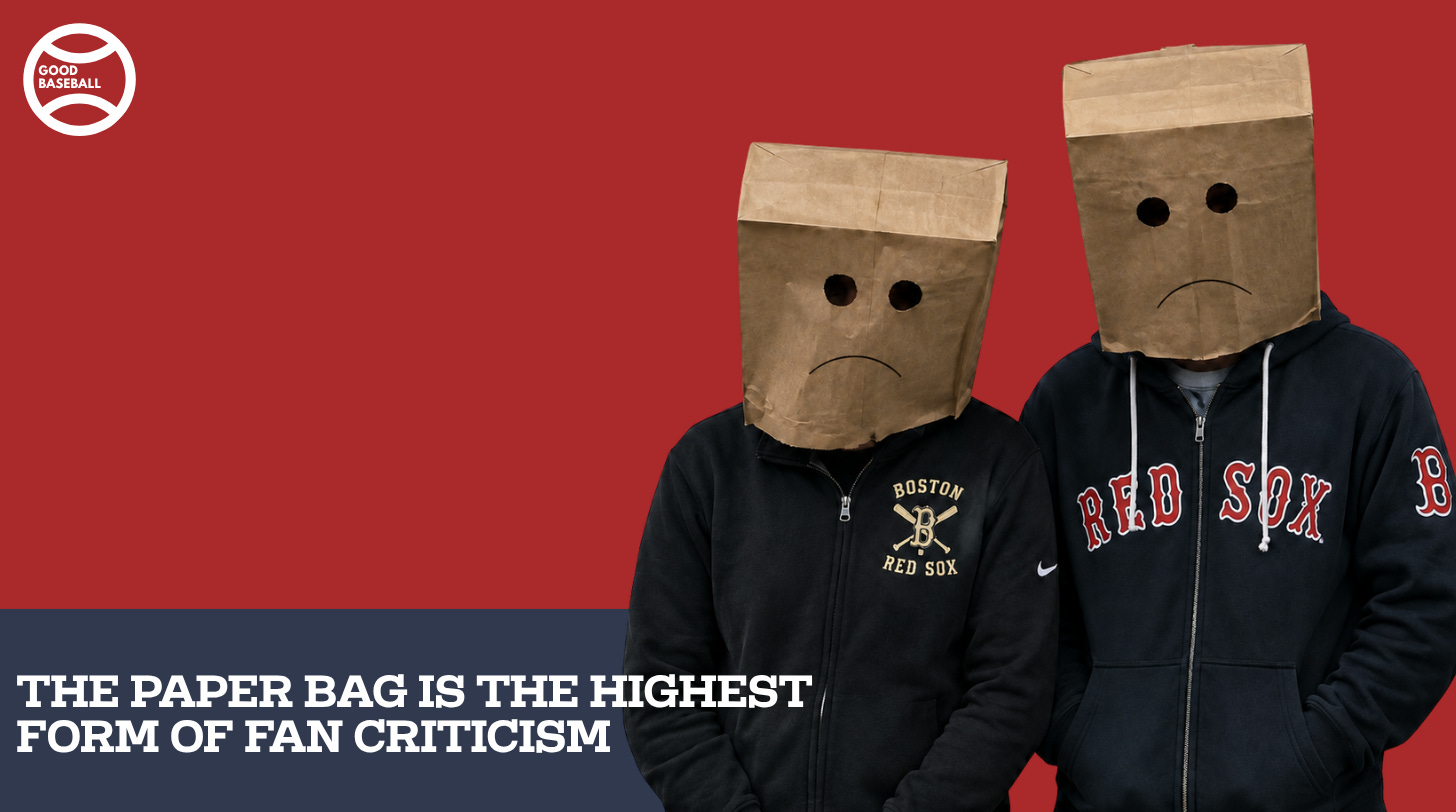
The Red Sox lost 2–1 to the Phillies, fell to 17–24, and in the ninth inning, two fans at Fenway Park put paper bags over their heads because sometimes the human face is simply too advanced for the product being placed in front of it. According to Yahoo Sports, the fans were reportedly either removed from their seats or told to take the bags off before the inning ended, which is an incredible organizational response because nothing says “we hear your concerns” like policing grocery-bag sadness.
And listen: I get it.
The Red Sox are not some experimental startup franchise that plays in a stadium sponsored by a cryptocurrency exchange and has a mascot named Blip. This is Boston. This is Fenway. This is the Green Monster. This is four World Series titles since 2004. This is a franchise with blood pressure, mythology, regional accents, and enough historical emotional baggage to qualify as a Ken Burns miniseries with a drinking problem.
So when the Red Sox are bad, fans do not react like normal people. They react like someone inherited a mansion and found out the previous owner replaced the hardwood floors with peel-and-stick bathroom tile.
That is what makes the paper bag funny. It is not just shame. It is curated. It is shame with supplies. The paper bag is the fan’s way of saying, “I am still here, but I do not consent to being visually associated with this operation.” It is the sports equivalent of putting your hoodie up in public after getting a bad haircut. You are present, but legally unavailable.
The paper bag has been around as sports protest language for decades, most famously with Saints fans during the “Aints” era. In 1980, the Saints started 0–14 and finished 1–15, and fans began showing up with brown paper bags over their heads, sometimes marking the bags with “Aints” instead of “Saints.” Local New Orleans sportscaster Buddy Diliberto is widely credited with helping popularize the gag, and it became one of the most durable symbols of fan disgust in American sports.
Which is hilarious because, as protests go, the paper bag is incredibly polite. Nobody is storming anything. Nobody is throwing anything. It is just a person sitting quietly with lunch packaging over their face. It is the most Midwestern riot imaginable. The French had the guillotine. Sports fans have two eyeholes and a Stop & Shop bag.
But that is also why it works. The paper bag is visual shorthand. You do not need a manifesto. You do not need a podcast. You do not need a 17-tweet thread titled “A few thoughts on roster construction.” You just cut two circles into a bag, put it on your head, and immediately everyone understands the thesis:
This team has made me anonymous from joy.
And in Boston, that hits differently. Red Sox fans are not asking for eternal dominance. They understand suffering. Their entire brand used to be suffering. Before 2004, Red Sox fandom was basically Catholic guilt with box scores. But there is a difference between tragic suffering and boring suffering. Tragic suffering gives you curses, near-misses, heroic failures, Aaron Boone nightmares, and old men staring into space at Dunkin’. Boring suffering gives you a 2–1 loss in May where everyone goes home feeling like they accidentally watched accounting.
That is when the bag comes out.
The bag says: I can handle losing. I cannot handle whatever this is.
And honestly, that is GOOD BASEBALL. Not because the Red Sox are good. They are currently doing that thing where a proud franchise looks around like it misplaced its own aura. But because fans still care enough to be mad creatively. Apathy stays home. Apathy watches something else. Apathy checks the score later and says, “Huh.” Paper bag fans are not apathetic. Paper bag fans are in the building, dressed like rejected mascots from a grocery chain, making a visual argument that the offense has become an issue.
That is love. Disturbed love, yes. Love that needs supervision. Love that maybe should not be sitting this close to children. But love.
And the funniest part is that teams always seem offended by the paper bag, as if the bag is the problem. The bag is not the problem. The bag is the Yelp review with shoulders. The bag is a wearable comment section. The bag is what happens when a fan base runs out of language and enters arts and crafts.
You know things are bad when the fan protest looks like a school project about the Great Depression.
But you also know the fan base is alive.
Because the opposite of the paper bag is not happiness. The opposite of the paper bag is empty seats. Silence. Shrugs. People deciding the team is not worth humiliating themselves over. A paper bag is embarrassing, but it is still participation. It is still attendance. It is still someone saying, “I hate this so much that I drove here.”
That is the strange beauty of it. The Red Sox fans under those bags were not hiding from the team. They were showing the team exactly what it had done to them.
Two eyeholes. Brown paper. Ninth inning.
A tiny monument to baseball disappointment.
Every so often, baseball remembers it is not supposed to be normal.
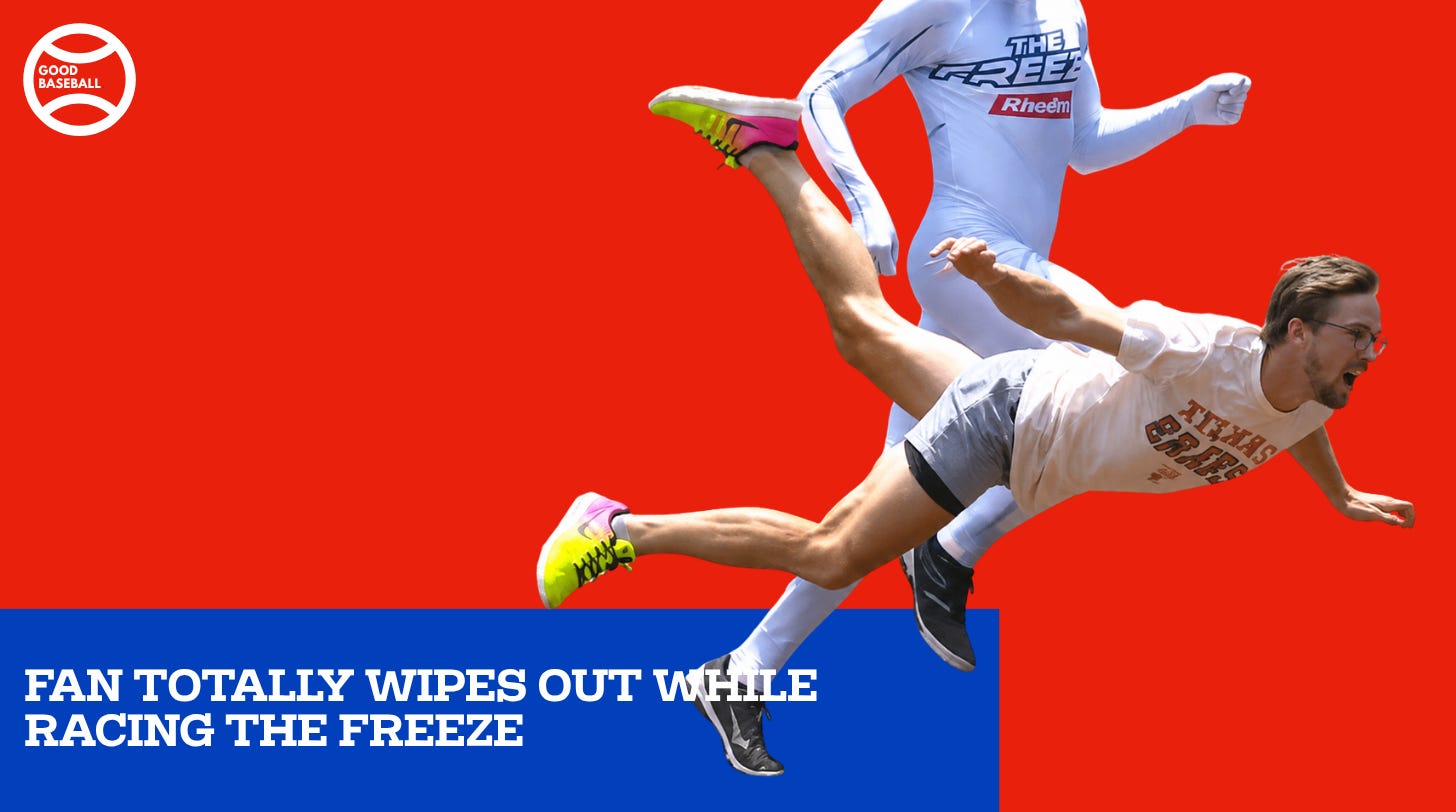
It spends nine innings pretending to be a serious sport with launch angles and leverage indexes and grown men in quarter-zips saying things like “damage in the zone,” and then suddenly between innings, a regular civilian in neon shoes is sprinting across the outfield against a man dressed like a human freezer pop, loses control of his entire skeleton, and achieves temporary flight in front of thousands of people who came to watch professional baseball but instead got a live-action physics lawsuit.
This is why baseball is good.
Not because the play mattered. It did not. Not because anyone’s WAR changed. It did not. Not because Rob Manfred’s office sat down and said, “What this sport needs is more airborne civilians.” Though honestly, that would be the first memo from them I respected.
It is good because baseball is the only major sport that has enough dead air, enough weird tradition, enough local carnival energy, and enough collective willingness to embarrass a paying customer in daylight to make this possible.
The Freeze is already one of baseball’s best bits because the premise is perfect: take a very fast man, dress him like a superhero sponsored by central air conditioning, give some poor fan a head start, and let everyone slowly realize the fan is not running against another person. He is running against dread.
That is the beauty of it. At first, the fan believes. They all believe. They take off with that dangerous civilian confidence, the kind you see at company picnics right before someone tears a hamstring trying to prove they “still got it.” For about seven seconds, the fan is the main character. The crowd is roaring. The gap looks real. The body feels young. The legs are lying, but beautifully.
Then The Freeze enters the frame.
And The Freeze does not run like a man. He runs like the future has sent someone back to correct your joy.
You can feel the crowd’s emotional math changing in real time. At first they are cheering for the fan. Then they are laughing because The Freeze is closing. Then they are screaming because the fan knows The Freeze is closing. Then the fan does the worst possible thing a person can do in public: he tries harder.
That is when the body holds a meeting and votes no.
This particular wipeout is spectacular because it is not just a fall. A fall is when a person descends. This man files for airspace. He becomes horizontal in a way usually reserved for Marvel characters, long jumpers, and toddlers diving onto couches because they believe gravity is optional if you commit hard enough.
His legs are behind him. His arms are out. His face is writing its own obituary. For one frozen second, he is not racing The Freeze. He is being spiritually repossessed by momentum.
And The Freeze is still just back there, moving like a silent assassin in compression gear.
That is the funniest part. The fan is having a full-body emergency, and The Freeze is simply continuing to be The Freeze. No panic. No chaos. No moral hesitation. Just aerodynamic cruelty. It is like watching a gazelle trip in front of a cheetah, except the cheetah has a Rheem sponsorship and probably does school appearances.
This is GOOD BASEBALL because this is what baseball understands better than every other sport: the game is not only the game. The game is also the stuff orbiting the game. The organ music. The between-inning races. The hot dog cannon. The mascot doing something legally questionable near the dugout. The dad in section 214 explaining to his kid that yes, technically, that man in white is called The Freeze, and no, we do not know why he is allowed to hunt fans.
Baseball has room for nonsense. That is one of its greatest strengths. Football is too militarized for this. Basketball is too cool. Hockey is already weird, but in a way that feels like it was raised by wolves and Zambonis. Baseball has the right amount of county fair in its bloodstream. It can host a serious divisional game and also pause everything so a random man can discover, in front of 38,000 people, that acceleration has terms and conditions.
And honestly, this fan deserves respect.
Not fake internet respect. Real respect. The man went for it. He did not jog. He did not do the ironic “I’m just happy to be here” shuffle. He ran like a man who had briefly convinced himself this could become the story he told forever. And it did. Just not the version he planned.
That is the risk of racing The Freeze. You think you are auditioning for glory. You are actually signing a waiver for slapstick immortality.
But that is also what makes it perfect. Baseball needs more of this. Not manufactured drama. Not another gambling graphic. Not another cut-in explaining barrel rate like the audience is trapped in an accounting seminar. Give me a man in bright shoes trying to outrun a corporate-sponsored speed demon and accidentally becoming a Renaissance painting about overconfidence.
Give me the crowd losing its mind over something that has no playoff implications whatsoever.
Give me The Freeze stalking joy from behind like a mythological consequence.
Give me one regular guy flying across the warning track because for six seconds he believed.
That is good baseball.
Stupid, beautiful, unnecessary, and absolutely essential.
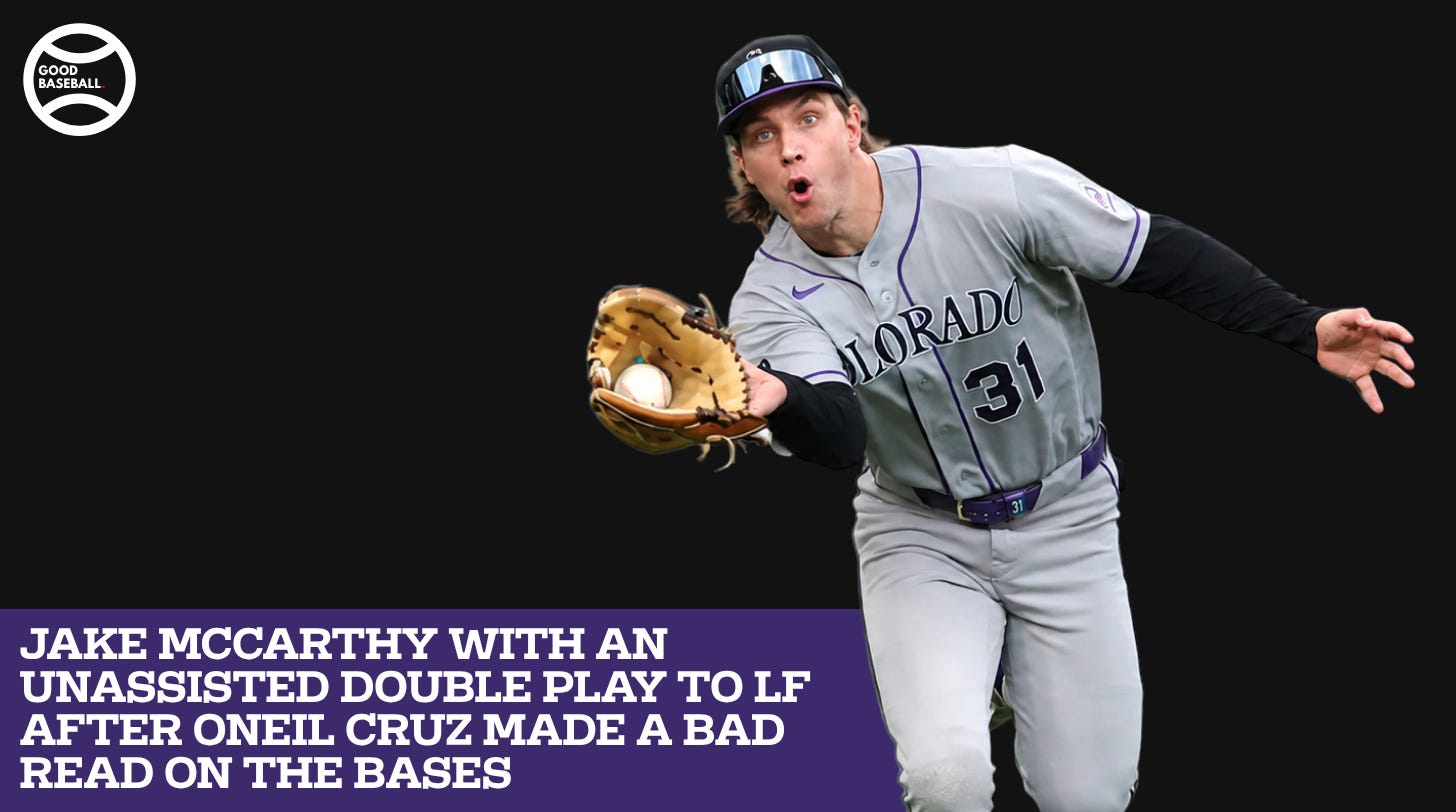
Jake McCarthy recorded an unassisted double play from left field against the Pirates, which is one of those baseball sentences that sounds fake until you remember baseball has spent 150 years quietly collecting loopholes like a bored lawyer with sunflower seeds.
Bryan Reynolds hit a sinking line drive. McCarthy charged in and caught it on a sprint. Oneil Cruz, who had started the play on second base, had already wandered near third like he was touring a model home. McCarthy realized this, kept jogging toward the infield, stepped on second, and became the first MLB outfielder with an unassisted double play since Jake Marisnick in 2015, according to ESPN Research.
That is Good Baseball.
Not just because it was rare, though it was rare. Not just because “unassisted double play by a left fielder” sounds like something you would invent in a baseball trivia night after everyone has had two beers and the host starts getting weirdly powerful. It is Good Baseball because McCarthy had the moment every kid secretly wants: the instant where you realize, Wait. I do not have to throw this ball. I can personally walk this man into the history books.
You could see it on his face, too. That tiny little smile when the internal baseball computer finished loading.
No, no, I ain’t throwing it.
I want to step on second.
I want this on my Baseball Reference page.
I want some guy in 2041 at a sports bar in Tucson to miss this answer during trivia and then slam his hand on the table when he hears my name.
That is what champions do. They recognize opportunity. Some champions hit walk-off homers. Some champions pitch complete games. Jake McCarthy saw Oneil Cruz standing too far from second base and said, “Actually, I will be handling all administrative duties on this play myself.”
And honestly, this is the kind of baseball play that feels like it should come with a children’s book diagram. It is so simple that it becomes confusing. The ball was caught. The runner had to tag. The runner did not tag. The left fielder just jogged to second base and ended the inning like he was returning a shopping cart.
There is something deeply funny about an outfielder recording a putout at second base without throwing the ball. Outfielders are supposed to throw from far away. That is their whole brand. Their job is distance, grass, sunglasses, warning-track anxiety, and occasionally pointing at the sky like they are receiving a message from God. They are not supposed to casually stroll into the infield and finish the play themselves. That is infield behavior. That is crossing department lines.
But that is what made it perfect. McCarthy did not panic. He did not air-mail a throw. He did not try to make the play look cooler than it already was. He just kept running, ball in glove, smile creeping in, while the entire situation slowly turned into a math problem Oneil Cruz had already failed.
And look, I get Cruz’s side, at least spiritually. A sinking liner is tricky. You are reading it off the bat. You are trying to score. You are Oneil Cruz, which means your legs are basically two illegal fireworks attached to a human torso. When you are that fast, every base probably feels like a suggestion. But this is how baseball gets you. The sport lets you feel powerful for one second, then immediately asks whether you remembered the rule from coach-pitch.
This also reminded me of the unassisted triple play I turned when I was about six years old, which I am bringing up because journalism demands transparency and also because I have been waiting decades to put this achievement in writing.
I caught a pop-up at third base, and apparently I was the only person on either team who understood the tagging-up rule. So I caught it, ran to second, touched the bag, then ran to first and touched that bag too. Three outs. No help. Just me, a glove, and what I assume was a scandalous amount of baseball IQ for a child whose postgame meal was probably a melted Push Pop and one warm Capri Sun.
Was it elite? Obviously.
Was half the other team crying because nobody knew what happened? Also yes.
But that is the thing about unassisted plays like this. They are not just athletic plays. They are awareness plays. They are “I know the rules and you don’t” plays. They are little acts of baseball bureaucracy weaponized against the confused.
Jake McCarthy did not just catch a ball. He noticed a loophole standing 90 feet away.
And then he walked over and closed it.

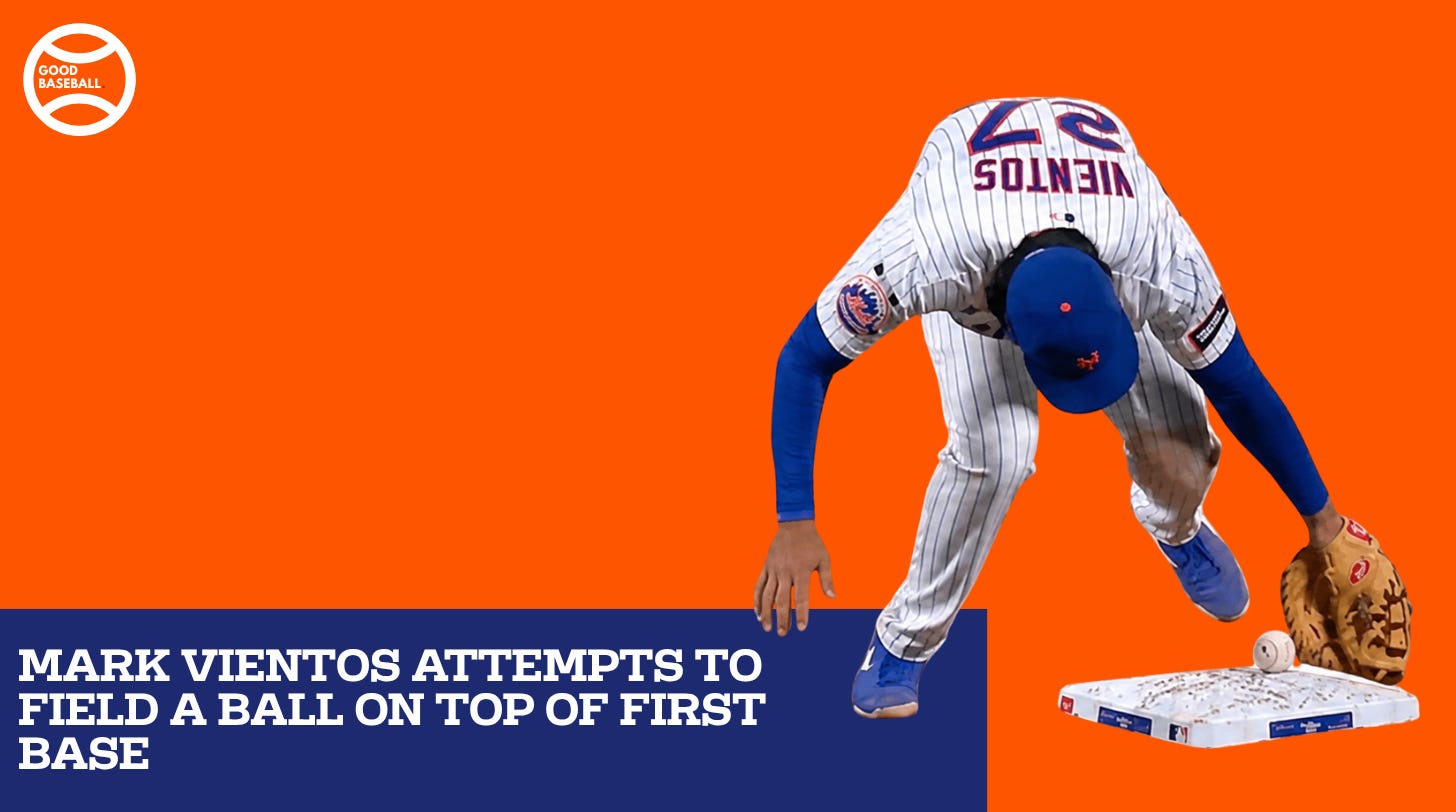
Mark Vientos is back in BAD BASEBALL, which means either I am bullying him or he has become this newsletter’s unpaid recurring character actor. Maybe both. Mark, if you are reading this: I am sorry. But also thank you for your service, because every time baseball starts getting too normal, you arrive like a man sent by the Department of Humor to remind us that the sport is mostly failure wearing pants.
This week, Vientos attempted to field a baseball while standing on top of first base, which is already a phrase that sounds like it should come with a court sketch. This was not a routine defensive miscue. This was a full-body software crash. It had layers. It had choreography. It had the haunting inevitability of watching someone carry too many folding chairs across a parking lot while pretending they still have the situation under control.
And the best part is they reviewed it.
Thank God.
Because normally replay review is baseball’s most advanced sleep technology. A manager points at a dugout phone, everyone stands around, three umpires put on headsets, and America gets to watch adult men determine whether a shoelace briefly achieved legal contact with a rectangle. It is a system designed by someone who thought baseball needed more zoning meetings.
But this review? This was art preservation.
This was the Louvre putting glass around the Mona Lisa. We needed the close-up. We needed the alternate angles. We needed the slow motion. We needed to see Vientos fall from five different perspectives like the Zapruder film if the central mystery was, “At what exact moment did his skeleton file a complaint?”
The thing about Vientos is that he does not move like a bad athlete. That would be too simple. He moves like a good athlete who has been cursed by a wizard who specializes in lower-body confusion. Not only does he run like there is a refrigerator strapped to his back, he also plays defense like the refrigerator is strapped to his back.
This was stoppable force meets movable object stuff.
The ball was there. The base was there. Vientos was also there, unfortunately, in the way a shopping cart is “there” when it is blocking the one open parking spot at Kroger. Everything technically occupied space. Very little of it cooperated.
Watching it unfold felt like one of those nature videos where the lizard tries to outrun the blind snakes. You know the clip. The lizard is panicking. The snakes are horrifying. Everyone involved appears to be operating on instinct. You are rooting for survival, but also you are aware the production crew has already chosen dramatic music. That was Vientos at first base. A man fighting gravity, geometry, and the concept of foot placement at the same time.
There is something deeply Mets about this, too. Not just because it involved a Mets player turning first base into a crime scene. But because Mets baseball has a specific flavor of disaster. Other teams make errors. The Mets produce weird little public incidents. Their mistakes feel directed. They have lighting. They have blocking. They feel like someone in the truck said, “Camera three, stay with him.”
And again, I do not want this to become an anti-Mark Vientos space. This is not personal. He can hit baseballs very hard, and that matters. But defensively, he sometimes looks like he is participating in a workplace team-building exercise where nobody told him the rules and one of the rules is “the ground is lava.”
The play itself was technically bad baseball, but spiritually? Extremely good baseball. Because baseball needs guys like this. Baseball needs the occasional moment where a professional athlete, one of the best baseball players on Earth by any reasonable measurement, gets undone by a ball, a bag, and the cruel laws of balance. It keeps the sport honest. It reminds us that even at the highest level, the game is still just a bunch of men trying to solve a moving object problem in front of 30,000 people.
If you don’t like that, you don’t like Mets baseball.
And if you do like that, congratulations. Mark Vientos has become a BAD BASEBALL legend. Again.
Which is unfortunate for him.
But important for us.
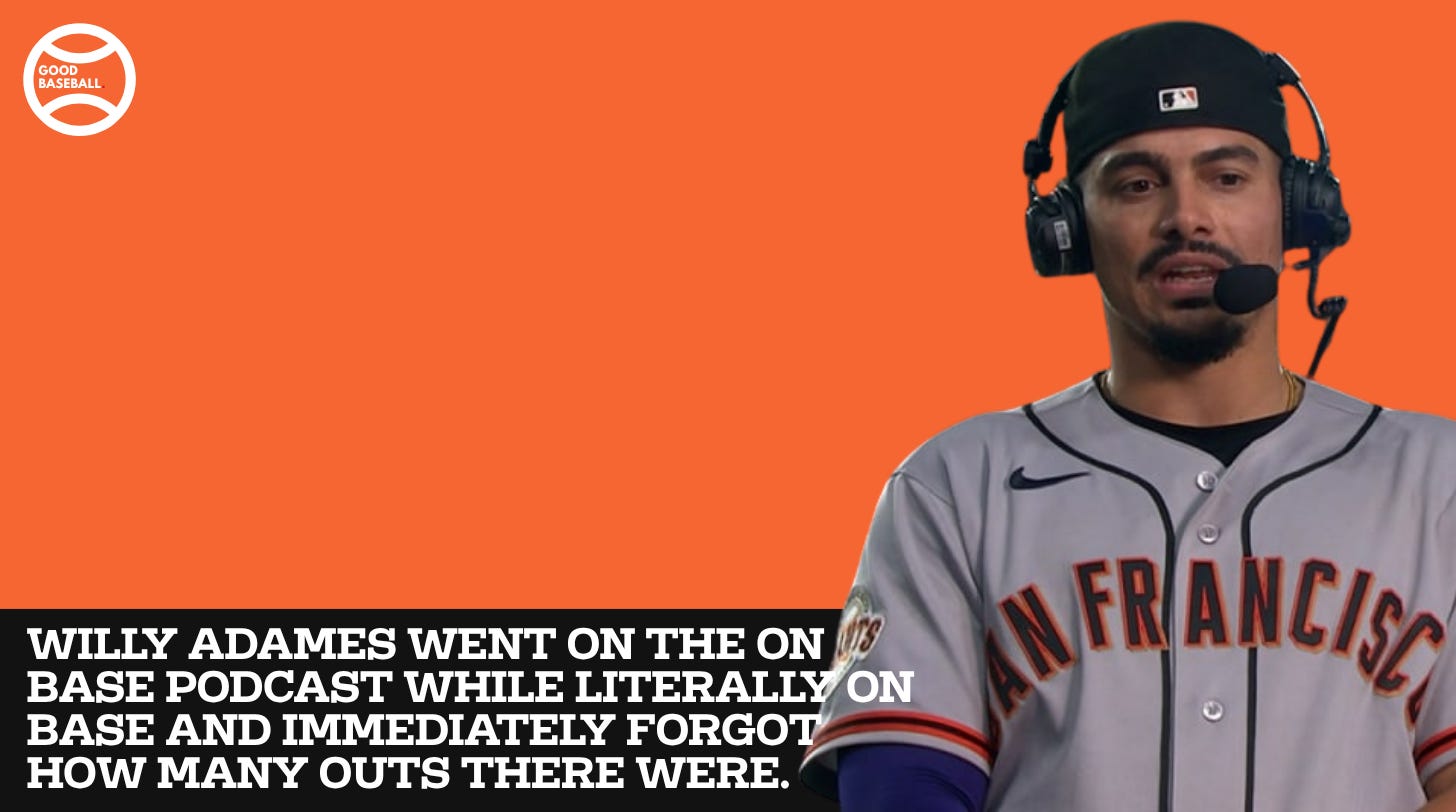
This is bad baseball. There’s no way to dress it up like it’s a fun little quirky content moment without also admitting that, yes, it is deeply insane to lose track of the outs because you were actively participating in a podcast while standing on second base in a Major League Baseball game.
That is not a normal sentence. That sentence sounds like something from a baseball-themed episode of 30 Rock where Tracy Jordan buys the Brewers.
Willy Adames was literally on base during On Base, which is already such a perfect bit that it should have caused the universe to pause and ask for a rewrite. Mookie Betts is talking to him. The game is happening. People are moving. There are outs. There are responsibilities. There is a third base coach standing there doing third base coach things, theoretically. And then Willy, very casually, enters the forbidden zone of modern content: being so locked into the segment that he briefly loses contact with the actual sport.
To his credit, he owned it immediately:
“That obviously is a mistake that can’t happen in a game. That mistake is probably the most ashamed that I would feel playing the game. I know that can’t happen. It was my fault. That’s on me.”
And, yeah. Correct. That is on him. That can’t happen. Gotta be better than that. Extremely “my bad, I forgot I was inside the game and not simply discussing the game as a concept.”
But also? At least 40 percent of the blame has to go to Dino Ebel/Borg/third-base-coach-adjacent adult supervision here. Once Willy gets halfway to third and there are not, in fact, enough outs for this to make sense, how is somebody not screaming GET BACK like the building is on fire? That is the entire point of a third base coach. He is basically a human stop sign with pants. If the runner starts drifting into traffic because he’s mid-podcast, you gotta become an air raid siren.
The funniest part is that the idea itself is actually incredible. Let players talk during the game. Let the pitcher interview the batter. Let two guys on opposing teams bullshit for nine innings like they’re stuck at a wedding reception table with no assigned seating. Baseball is already weird and slow and full of little pockets of boredom where a first baseman and baserunner discuss restaurants, golf, taxes, and whether the shortstop is “always like that.” Put a mic on it. Make it a whole thing.
But maybe — just maybe — don’t do it while someone is responsible for remembering the number of outs.
Because this was a bad look. Real bad. Funny? Absolutely. Content gold? Tragically, yes. Good baseball? No. This was baseball slipping on a wet floor while holding a microphone.
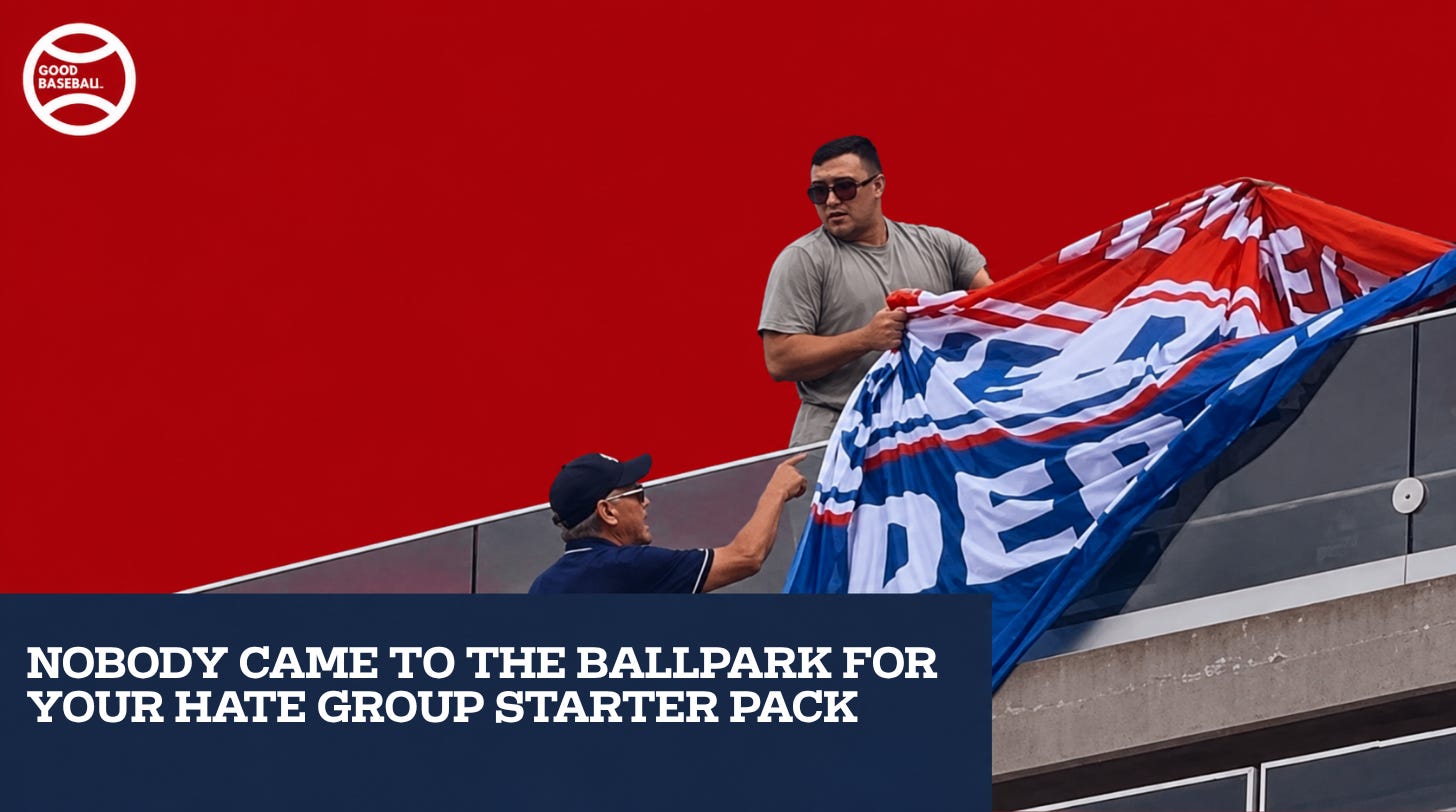
This is bad baseball.
Not bad baseball like a TOOTBLAN, or a reliever walking the nine-hole hitter on four pitches, or a manager doing that thing where he strolls to the mound looking like he’s about to ask for directions to a Bass Pro Shops. This is actual bad baseball. The kind where the game gets interrupted by a guy dragging his own little sewer ideology into a place where people are supposed to eat nachos, boo middle relievers, and explain the infield fly rule incorrectly to a child.
During Sunday’s Nationals game at Nats Park, individuals unfurled a banner that directed fans to a white nationalist website and called for the deportation of “100+ million.” The Nationals said they identified and banned at least one person, and the team condemned the hateful rhetoric while saying the ballpark is supposed to be a safe space for fans. Jake Lang, described by Reuters as a Jan. 6 rioter and conservative influencer, later took credit for the banner on social media.
So, yes: this guy fucking sucks.
There are levels to being annoying at a baseball game. You can be the adult who brings a glove and knocks over a kid for a foul ball. You can be the guy who screams “THROW STRIKES” after every ball like he just solved pitching. You can be the person trying to start the wave in the third inning of a 1-1 game, which should technically be a misdemeanor. But sneaking in a white nationalist banner? That’s not annoying. That’s taking the worst group chat in America and trying to hang it from the upper deck.
Baseball already contains enough suffering. The Nationals lost 7-3 to the Orioles. That is sufficient pain. Nobody also needs discount fascism with their helmet nachos.
And the dumbest part — beyond the obvious moral rot, beyond the racist spectacle, beyond the desperate little “look at me” theater of it all — is that these guys always act like they’re being brave. Brother, you brought a banner to a baseball game and ran away when an usher came over. That is not courage. That is Etsy Mussolini behavior. That is what happens when a comments section grows legs and discovers stadium seating.
Credit to the Nationals for banning him immediately. That’s the correct response. No “both sides,” no “we’re reviewing the matter,” no soft-focus PR oatmeal. Just: get this trash out of the ballpark. Baseball parks are not perfect civic temples or anything — they charge nine dollars for water and make grown adults emotionally dependent on bullpen depth — but they are still one of the few public places where everybody agrees to care about something stupid together. That’s the bargain. You sit near strangers, complain about umpire zones, eat food shaped like a dare, and briefly become citizens of the same dumb little republic.
This guy tried to poison that.
So, yes, bad baseball. Bad person. Bad banner. Bad everything.
The only good part is that he is banned from Nats Park, which means the next time Washington plays at home, fans can get back to the normal business of baseball: watching a 2-2 slider miss by six inches, booing like democracy depends on it, and not being forced to share oxygen with a man whose entire personality appears to be “what if a YouTube comment section committed trespassing?”

Aroldis Chapman turned a bases-loaded rocket off his foot into the final out, because apparently throwing 100 isn’t dramatic enough anymore.

On May 16 against the Blue Jays, Tigers right-hander Casey Mize delivered one of the nastiest pitches of the week, ending a second-inning battle with Jesús Sánchez on a splitter that completely disappeared beneath the zone.
I love when hitters react mid-swing because you instantly know the pitch was absolute nonsense.
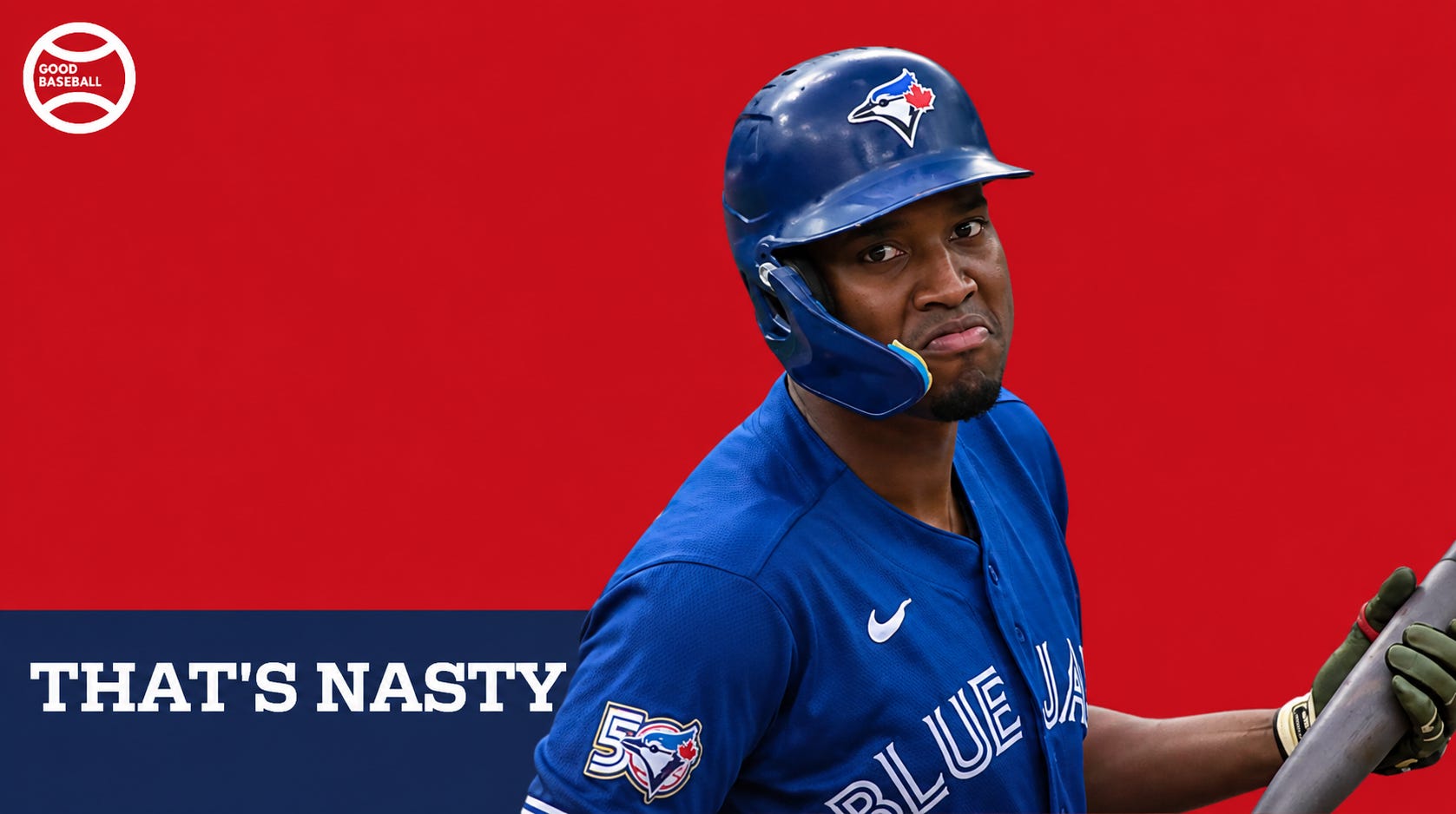

May 16 vs. Cubs — 3rd inning — Colson Montgomery hit a baseball 442 feet, which was the longest homer in MLB this past week and tied for 36th-farthest this season. Very normal thing to do if you are mad at a small white object and also gravity.

The Guardians being 21-21 and the only team that has neither swept nor been swept is extremely Guardians. They don’t dominate you. They don’t embarrass themselves. They just show up, split the bill, drive the speed limit, and leave the series feeling like both teams learned something about moderation.
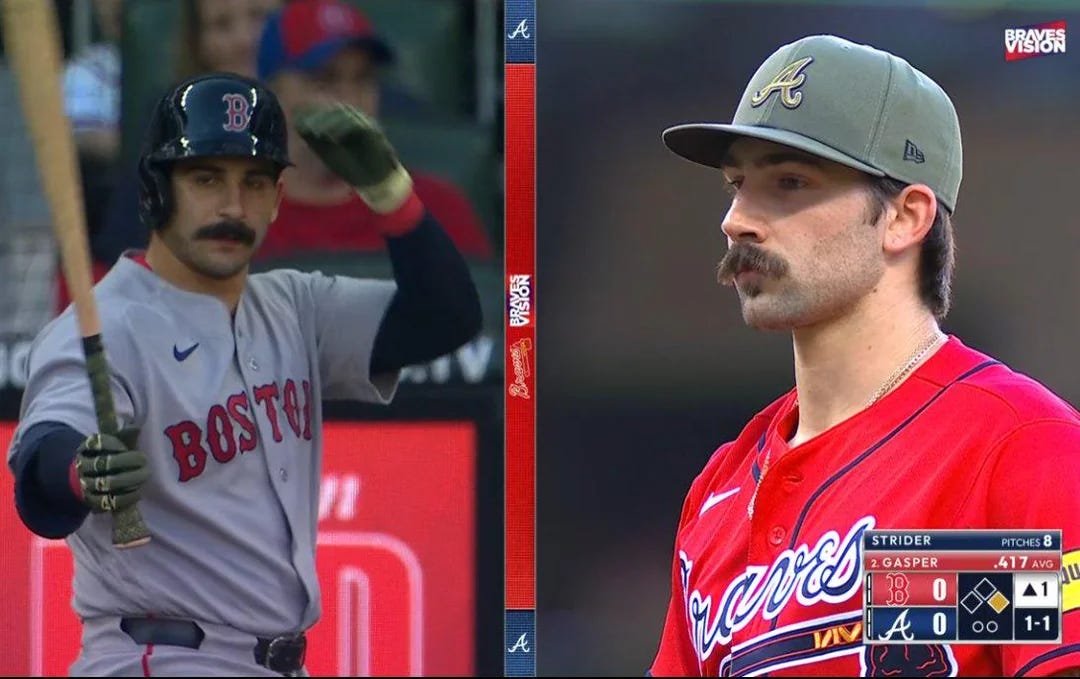
Spencer Strider vs. Mickey Gasper looked like two men from 1887 announced by a man in suspenders yelling “GOOD HEAVENS.” If Strider threw it any lower, Gasper was headed to Hades for the apple.
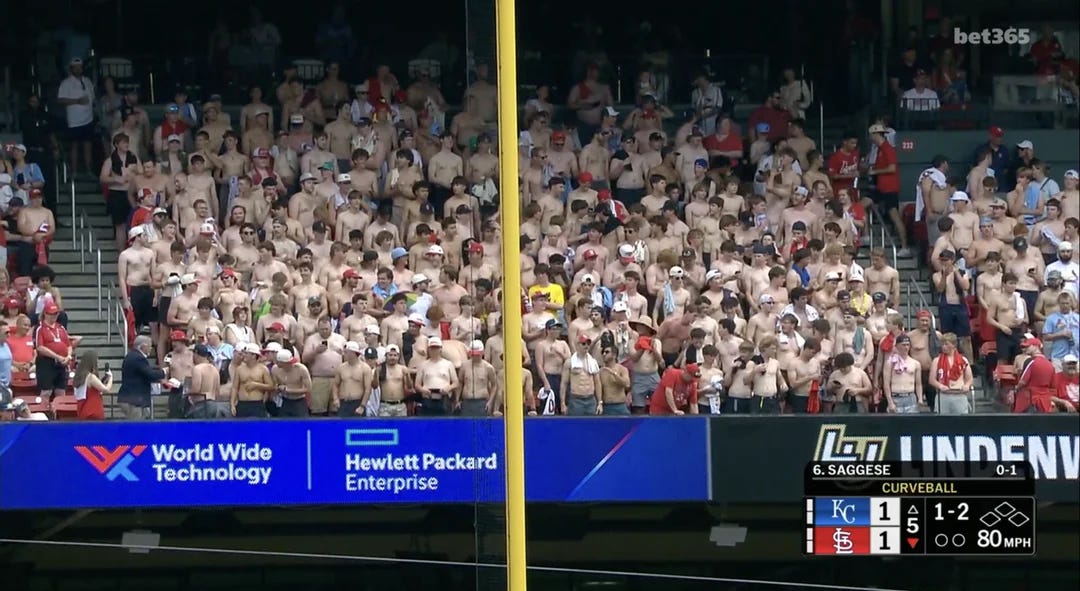
Buying 1,500 tickets so the shirtless bros could keep Busch Stadium operating at maximum vibes is exactly the kind of baseball decision I support without reading the fine print. Managers love saying they’re “building culture.” Brother, that is culture. That is 1,500 sunburned torsos turning left field into a municipal event. That is leadership with chest hair.
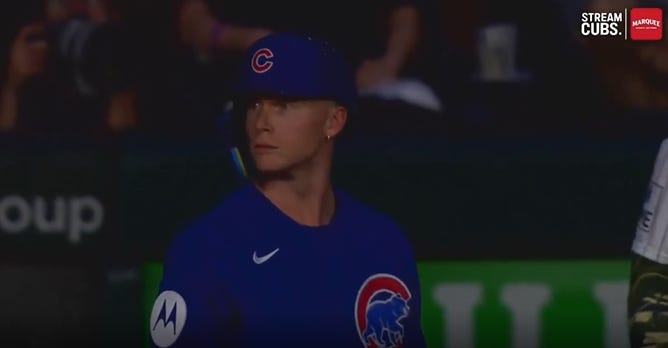
Pete Crow-Armstrong heard the Undertaker gong mid-at-bat and immediately became the most reasonable man in baseball. You cannot expect a guy to track spin when the ballpark turns into Monday Night Raw and briefly suggests he’s about to get Tombstoned before the next pitch.
The Dodgers losing four straight by 4+ runs for the first time since 1936 is an insane stat because the Dodgers have basically spent the last decade operating like baseball’s gated community. And of course it’s the scrappy little 2026 Dodgers — just a plucky underdog collection of MVPs, Cy Young arms, and GDP-level payroll — that finally brought back Depression-era suffering.
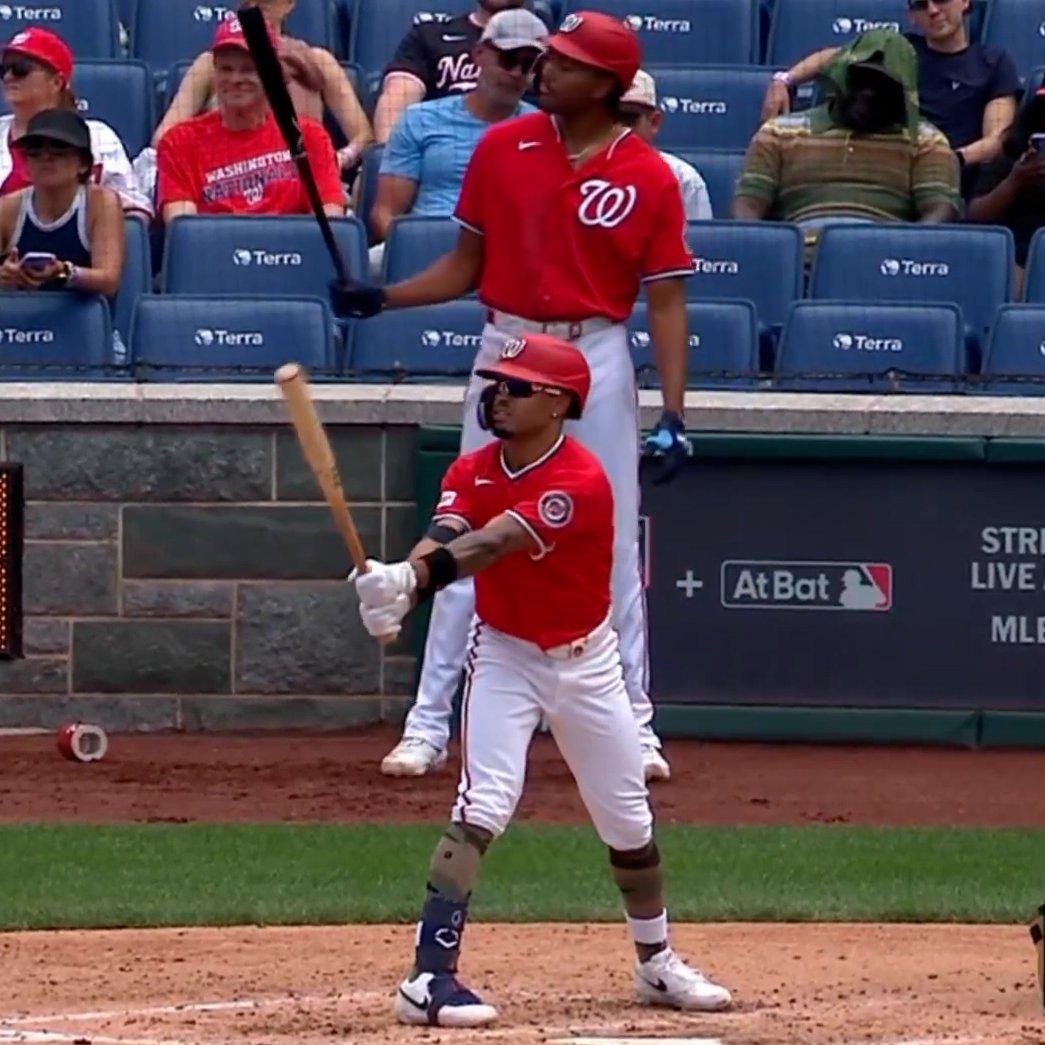
5'8" to 6'6" in one frame. This is the new Altuve/Judge photo, except somehow even funnier because James Wood looks like Nasim Nuñez’s created player after three seasons of franchise mode upgrades.
The Phillies under Don Mattingly have become baseball’s funniest argument against overthinking. They were 10 games under, brought in one man who looks like he knows exactly where the spare extension cords are, and immediately went 15-4.
The American League has four winning teams. The NL Central has five. Please respect the new financial capital of baseball: whatever is happening between Milwaukee, St. Louis, Chicago, Pittsburgh, and Cincinnati.
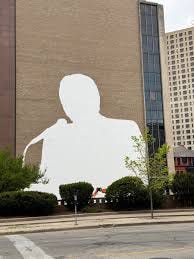
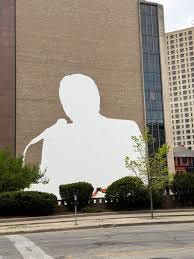
Milwaukee giving Bob Uecker a 100-foot mural feels correct because Uecker was never just a baseball guy. He was baseball’s inner monologue after three beers and one bad inning.
Closing Note
So that’s the week.
A guy flew through the outfield racing The Freeze. A left fielder turned an unassisted double play like he had discovered a loophole in municipal law. Mark Vientos fought first base and somehow first base won. Willy Adames got interviewed while literally on base and forgot the part where baseball continues happening during content. The Giants celebrated in Dodger Stadium like the outfield had briefly become a crime scene with choreography.
And then there was Bob Uecker on the side of a building.
That feels right. Because this week had the full baseball buffet: stupid, beautiful, embarrassing, rare, cursed, funny, and occasionally infected by the worst guy you’ve ever seen holding a banner. It was baseball as slapstick. Baseball as civic ritual. Baseball as public shame. Baseball as three hours of sport and 45 minutes of “wait, what the hell was that?”
Most weeks, baseball does not explain itself. It just hands you a paper bag, a 442-foot homer, a guy in glasses holding a hate sign, a splitter that vanishes into the earth, and 1,500 shirtless dudes in St. Louis and says, “Good luck organizing this emotionally.”
But that’s the job.
You take the weird parts seriously and the serious parts weirdly.
You boo the fascist. You salute Uecker. You respect The Freeze. You do not podcast while responsible for knowing the outs.
That’s Good Baseball.